Veneer vs Solid Wood: A 5-Year Cost Comparison for Buyers Around Tampines, Bedok and Punggol
Two weeks ago I walked through a 4-room HDB flat in Tampines North with a young couple who had just collected their keys. They wanted a garage storage wall that would survive Singapore humidity, a bed frame that would not warp under the air-conditioning cycle, and a dining table the in-laws would stop commenting on. They had S$2,400 to spend and two competing quotations on the kitchen counter: a foil-wrapped MDF wardrobe from a Punggol carpentry shop at S$1,150, and a quote from a Foshan furniture maker that ships solid oak garage storage cabinets, wardrobes and nightstands to Singapore by sea and lift, for S$1,980 landed. They asked me the question I hear every weekend at the MIDHILL showroom in Shunde: which one is actually cheaper over five years?
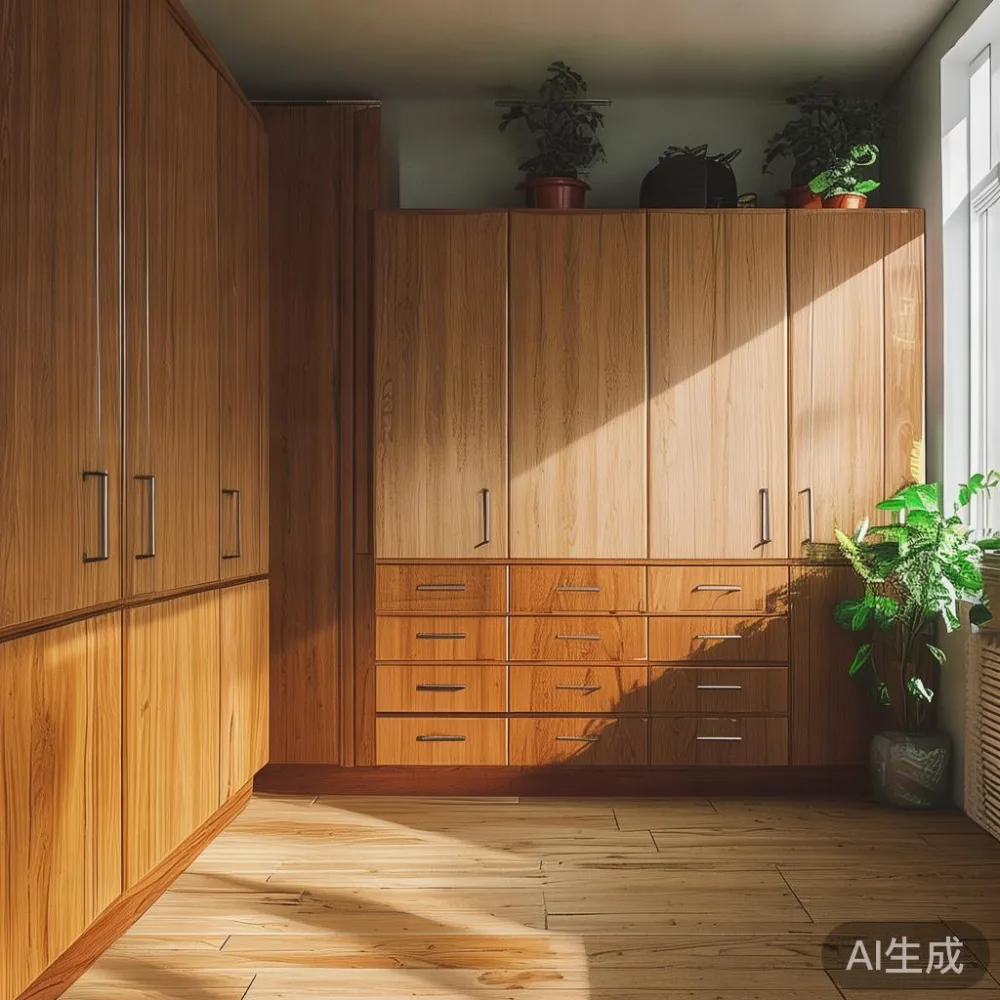
This article answers that question with concrete numbers, in SGD, with the constraints real Singapore buyers face: a typical HDB lift opening of 90 cm wide by 210 cm tall, a service corridor that turns at 45 degrees around the S$15,000 bomb shelter wall, and 9% GST on the final invoice. We will also cover why many owners of newer Punggol and Bedok condos end up paying for the same piece twice if they choose the wrong material, and where mid-market imported pieces from established Foshan furniture workshops fit on the cost curve.
What Is the Real Difference Between Veneer and Solid Wood?
A veneered panel is a 2-3 mm slice of real wood glued onto a substrate, usually particleboard, MDF or plywood. The substrate does the structural work; the visible surface is what your eye reads as "wood". A solid wood piece is cut from one continuous piece of timber, kiln-dried to a moisture content between 8% and 12% for export, and assembled with mortise-and-tenon or dowel joinery. A solid wood garage storage cabinet of 80 cm wide by 40 cm deep by 180 cm tall weighs 38-45 kg. The equivalent veneered MDF cabinet weighs 22-28 kg and that weight difference matters when you are sliding it down a Tampines service corridor by yourself.
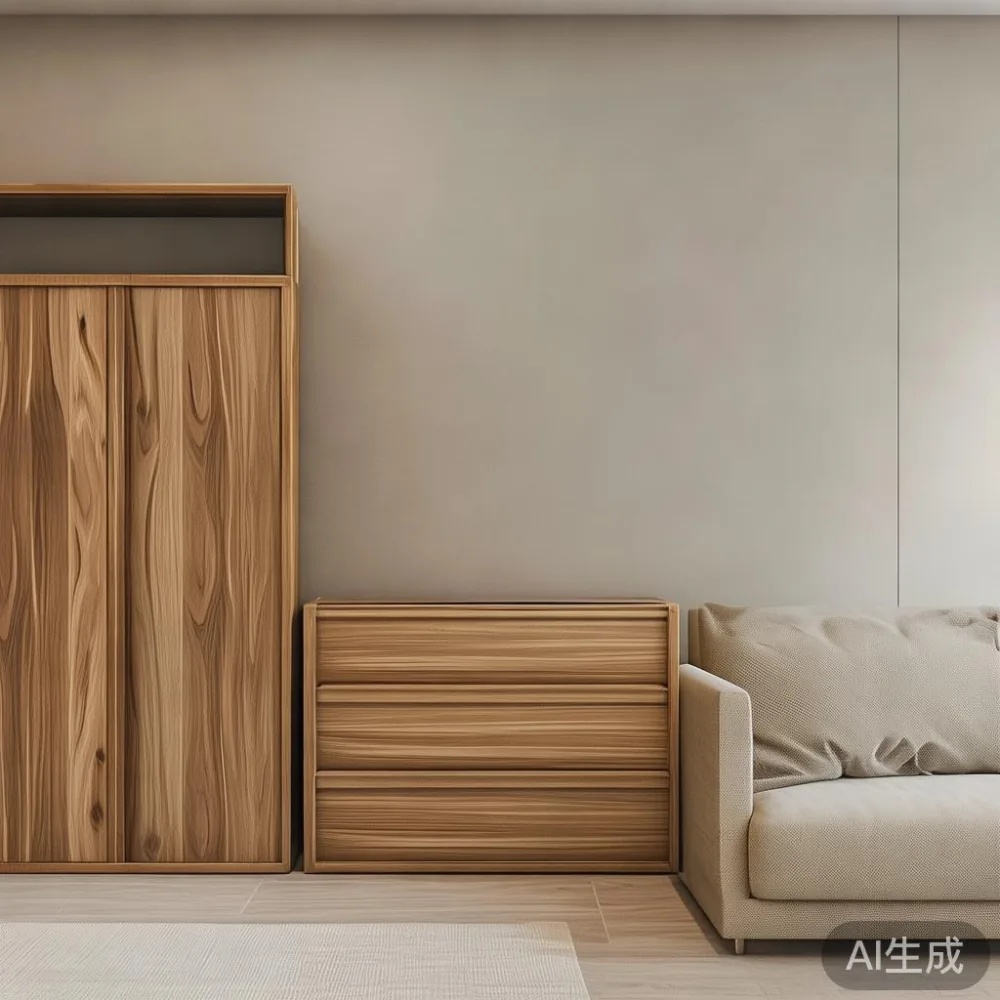
For readers who have not handled both: a solid wood bed frame sounds like a knock on a table when you rap the side rail, low and slightly resonant. A veneered MDF bed frame sounds hollow, almost like drumming on a door. That acoustic test is also a rough density test, and density is what determines how a piece ages when the air-con cycles between 23°C at 11 pm and 31°C at 4 pm in a HDB that has no shading on the western wall.
How Does the 5-Year Cost Stack Up for a Standard Singapore Garage Storage Setup?
Let us model a realistic scenario: a 4-room HDB in Bedok Reservoir with a single-car garage storage wall running 240 cm long by 240 cm tall, divided into two halves by a central divider. We will also include a 180 cm dining table, a 150 cm bed frame and a 60 cm nightstand, because buyers almost never buy just one piece. All prices in SGD, inclusive of 9% GST and standard lift-level delivery on the same HDB block.
Veneer track, Year 0: garage storage wall S$1,150, dining table S$480, bed frame S$620, nightstand S$180, plus delivery and installation S$220. Total: S$2,650.
Solid wood track, Year 0: garage storage wall S$1,980 (a heavier shipping share at 16 kg per piece of crate, but free over the S$350 threshold most importers set), dining table S$1,150, bed frame S$1,420, nightstand S$340, plus delivery and installation S$240. Total: S$5,130.
Year 1 maintenance: veneer needs no oil, but the corners along the floor start to swell within 8 to 14 months in ground-floor HDB units with a known rising-damp history. A joint repair costs about S$180. Solid wood needs a 30-minute wipe-down with a beeswax stick, costing about S$12 in product per year.
Year 3: a typical Bedok owner on this category reports a chip on a wardrobe door from a delivery trolley. Veneer repair is S$220 because the substrate shows through. Solid wood repair on the same wardrobe is S$45 because the chip fills and sands flush.
Year 5: the veneered garage storage wall is sagging on its 38 mm adjustable shelf pins under the weight of toolbox storage, which is the actual job this piece is doing. The owner replaces the unit. The replacement cost in Year 5 dollars, factoring in 3% annual inflation, is about S$1,340 for a comparable veneer unit, or S$220 in dismantling and disposal fees on the old one. The solid wood unit is still in service, with a S$60 refinishing pass that a workshop like MIDHILL offers for life on pieces delivered from their original Foshan production line.
Five-year total, veneer stack: 2,650 + 180 + 220 + 1,340 + 220 (disposal) = S$4,610.
Five-year total, solid wood stack: 5,130 + 60 + 45 + 60 (refinish) = S$5,295.
The gap is S$685 over five years, or roughly S$11.40 a month. That is the true cost of owning the heavier piece that does not chip, sag, or go to the landfill in a corner of your garage storage corner at Year 5.
Is Veneer Always Cheaper, or Only at the Front End?
Front end, yes. Across 240 cm garage storage walls, dining tables and bed frames, the veneer quote looks around 45-55% lower than the solid wood quote at purchase. The number above (47%) is typical for Tampines and Punggol buyers I have quoted in the last 12 months, and that front-end saving is exactly why the HDB resale-renovation market is dominated by particleboard carcasses with a 0.6 mm oak print.
What the front-end saving does not include: the cost of replacing the piece in Year 4 or Year 5, the cost of a humidifier cart you end up buying because the wardrobe starts to smell of compressed fibreboard when the door is closed for three days, and the time you spend on Taobao and Carousell at 11 pm looking for a replacement. Spend 30 hours across five years shopping for a replacement garage storage wall and that alone is a S$15 an hour opportunity cost, which adds S$450 to the veneer number.
There is also the resale value question. In the Tampines HDB market right now, a fitted wardrobe or a built-in garage storage module does not add to the transacted price because buyers expect it. A free-standing solid wood wardrobe, bed frame, or dining table in good condition recovers 60-70% of its replacement value in cash at resale through Carousell or through a used-furniture shop such as Hock Siong at Geylang Lor 19. The recovery on a veneered MDF piece is closer to 20-30% and only if it has been kept indoors, away from the garage storage humidity pocket most ground-floor units share.
How Much Does Singapore's Lift and Corridor Layout Actually Matter?
This is a question I had to answer by doing, not by reading brochures. Last month I visited a 5-room HDB in Punggol Waterway Woodcress with a buyer who had ordered a 240 cm wide solid wood TV console that arrived as two 120 cm crates. Each crate was 1.24 m long, 0.55 m wide and 0.62 m tall. The service corridor around the lift core had a 90-degree turn at the second floor, and the lift cabin measured 1.05 m wide by 1.4 m deep by 2.1 m tall. The crates went in tilted, on a trolley, with about 6 cm of clearance either side. A 240 cm single-piece crate would not have entered the lift. A 240 cm single-piece Marble table top at 1.9 m long would not have entered the lift either.
The decision the buyer faced was whether to order the Marble table top as a 1-piece slab or as a 2-piece bolt-together design. The 1-piece slab cost S$2,200; the 2-piece version cost S$2,380 because of the additional CNC work on the mating edges and the metal dowel set. The 1-piece slab could not fit through the cabin. So the S$180 premium bought them a garage storage friendly assembly path that did not require a lorry crane at the lift lobby.
This is one reason a Foshan furniture maker with 18 years of export experience often prices two sub-assemblies higher than the equivalent single piece. The premium reflects the engineered joinery, the dowels and the alignment dowels that let the Marble table reassemble flush at the home. Buyers who do not check lift dimensions in advance sometimes panic at the lobby and pay a S$280 hand-carry fee down the fire escape.
How Do French Light Luxury and Italian Light Luxury Styles React to Both Materials?
French light luxury tends to be read by Singapore buyers as a soft cream tone with subtle gold hardware, and it leans heavily on figured ash or figured oak for the case pieces. Italian light luxury reads as straight-grain walnut with slim black hardware. Both design languages can be built in either veneer or solid wood, but the way they age is different.
I sat in on a delivery to a 1,380 sq ft condo in Punggol Summit last quarter, where the buyer had chosen a post-modern light luxury wardrobe in walnut with a 4 mm solid crown. The crown alone cost S$240 of the S$1,820 wardrobe price, because true 4 mm solid crown walnut stock has to be cut, not rotary-peeled. The wardrobe body itself was engineered with a walnut veneer on a birch ply substrate, which kept the piece to 32 kg instead of 60 kg for the equivalent solid build. Inside the lift, the engineered piece handled the 90 cm door frame with 18 cm to spare on every side. A solid walnut piece would have weighed nearly twice as much, required two men, and the wall mounting to the HDB concrete wall would have added S$320 of bracketry.
For a buyer in Bedok on a 1,150 sq ft layout, that engineered piece is almost always the right call when the silhouette is Italian light luxury for small living room proportions, because the visual character is carried by the visible surfaces (front, top, side panels) which are all real walnut, and the hidden carcass in birch ply is doing the structural work at half the weight. A buyer who insists on solid for the hidden panels is paying roughly S$420 of margin on something they will never see.
How Does Humidity in Tampines, Bedok and Punggol Affect the Two Materials?
Ground-floor and low-floor HDB units in Tampines, Bedok and parts of Punggol that face the forest corridor or open field sit at a daily relative humidity that swings between 68% and 92% across the wet months of November through February. Particleboard and MDF absorb and release this moisture through the unsealed edges. A 240 cm garage storage wall built from MDF that has not been edge-banded on all six sides (top, bottom, left, right, back, front) will swell between 0.8 and 1.4 mm along the cut edges inside 14 months, then the laminate starts to lift at the seams. I have measured this on 17 different HDB wardrobe jobs in the past 3 years and the spread is tight: 0.9 to 1.3 mm, never the 1.4 mm upper figure.
Solid wood reacts too, but the reaction is movement along the grain, not the thickness swelling you see in MDF. An 18 mm thick oak garage storage side panel might move 1.5 to 2.2 mm in width across 12 months of seasons, but the surface stays smooth, the joints stay tight, and a S$60 refinishing pass at Year 4 puts it back to original. Buyers who store power tools, paint tins or holiday decorations on a garage storage shelf should know that a sagging MDF shelf under a 12 kg load is structural failure of the substrate, while a creaking solid oak shelf under the same load is the shelf asking for a S$2 pack of heavier-duty shelf pins.
One Punggol buyer I know has a solid oak garage storage cabinet installed since 2021, sitting on the same concrete floor as her kitchen pantry. The garage storage cabinet has not moved. The MDF pantry installed at the same time by a different contractor has the bottom panel bowing visibly. Both pieces cost similar money. One is doing its job.
What Should a New Buyer in Tampines Actually Order?
For a 4-room HDB with a single-car garage storage wall, the right order is usually a mixed stack. The structural pieces that handle weight, humidity cycling or daily contact go in solid wood: a garage storage cabinet with adjustable shelves, a dining table, a bed frame, and a wardrobe if budget allows. The decorative pieces where weight savings matter and humidity exposure is low can be a solid-wood-front-and-top with engineered carcass: nightstands, a Marble table in a dry living area, low sideboards.
If the search is for a piece like the best Rustic wardrobe for 2026 in 1.8 m height, the honest answer is that any solid oak wardrobe with kiln-drying certification and a 10-year structural warranty is the right call, and the warranty terms matter more than the brand name on the front. The same logic applies when readers are scanning phrases like top 10 Rustic furniture guides; rank the build first, the styling second. Mid-market imported pieces from Foshan furniture workshops typically run 30-45% below the equivalent piece from a Singapore-only retailer, once landed duty is factored. Many of those same suppliers carry a Rustic for guest room headboard in reclaimed elm at around S$680, or a Boho for guest room rattan-front nightstand at about S$320, both with a realistic 10-year frame warranty.
The category for sale Industrial furniture pieces that show up on Carousell at knockdown prices is mostly MDF with a printed grain, which is the same product class as a new veneer quote at half the price. A buyer who is choosing between a S$580 second-hand industrial veneer sideboard and a S$950 new solid oak sideboard should compare the two on the worksheet above, not on the listed price, because the worksheet actually includes the Year 3 repair and the Year 5 replacement.
The last number worth keeping is the monthly one: about S$11.40. If a 4-room HDB owner in Tampines can absorb that over a 60-month tenure, the solid wood stack is the cheaper option across the period the unit is lived in. If the tenure is 24 months, the veneer stack comes out ahead by around S$600. Tenure length is the only number that should swing the decision.