Buying a Sofa You Cannot Sit On: A Singapore Buyer's Pre-Purchase Checklist
A sofa you cannot sit on sounds like a riddle, yet in Singapore it is a real scenario. The unit is still in a carton, on a pallet, or wedged into your Tampines HDB corridor at 11.40 pm. The decision was made hours or weeks ago, and the only thing left to verify is whether the thing in front of you actually matches what you paid for. Last month I met a homeowner in Punggol who unboxed a 2.4 m solid wood sofa only to discover that the backrest cushions had been swapped for a thinner foam grade. She had no recourse because she had not photographed the carton label or weighed the package on arrival. This guide is built around the minutes and hours that follow a delivery, not the glossy showroom visit.

For Singapore buyers ordering from overseas factories such as Foshan-based manufacturers like MIDHILL, the unboxing window is also your warranty window. A 10-year structural warranty and a lifetime refinishing service only hold value if you can prove what arrived and how it arrived. With corridor widths in most HDB blocks capped at roughly 1.2 m and lift openings near 0.9 m, the path from the delivery van to your living room is also part of the purchase decision. Below is the field-tested checklist I now share with friends furnishing three- and four-room flats in Bedok, Toa Payoh, and the newer Punggol BTOs.
What size desk do I need?
Measure the intended wall, then subtract 12 cm for breathing room and another 10 cm for skirting or power trunking; for a 2.4 m sofa delivered to a typical 3 m HDB living room, this leaves a 1.65 m wall clearance that still allows a 140 cm desk with a chair pulled out. Apply the same logic to every large piece you order, because a Japandi walnut bed frame at 180 cm long plus a 60 cm wardrobe gap can swallow a small bedroom faster than expected.
Pre-Order Measurements You Should Already Have Saved on Your Phone
Three numbers matter before a single cent leaves your account: the lift door width, the corridor turning radius, and the internal doorway of your flat. In a standard HDB block the lift car is around 1.1 m deep and 1.4 m wide, while the door opening sits closer to 0.9 m. A solid wood sofa frame at 2.2 m long usually clears a straight corridor, but a 2.6 m L-shape will not make the corner into your unit without the legs unscrewed. Measure diagonally from the lift to the final placement corner, and add 15 cm for hinge clearance and the installer's hand grip.
Condo corridors in developments around Tampines and the east region often run narrower than HDB because of fire-rated door swings and planter boxes. If you are on a high floor, weigh the package against the lift's posted load limit (commonly 630 kg or 1000 kg) and divide by the piece count. A single solid wood sofa can weigh between 75 kg and 110 kg, and a marble table crate adds another 90 kg to 140 kg before the nightstand or dining chair boxes join the trip. Knowing the total kilogram load keeps you safe and keeps the delivery crew from refusing the lift.
What to Photograph the Moment the Carton Lands on Your Floor
Start with the carton label, then the four vertical edges, then the base pallet. The label carries the SKU, the batch number, the gross weight in kilograms, and the country of origin. A MIDHILL carton I checked in a Jurong warehouse last quarter showed the FSC code, the piece count, and the date stamp printed within a 10 cm x 15 cm panel, which is the panel to capture in three frames: wide, medium, and close-up of every line. Photograph the carton before the wrapping is cut, because the wrapper photo is your evidence that the piece arrived unopened from the factory, not re-taped by a middleman.
Then photograph the foam caps, the corner protectors, and the wooden crating around the legs. If a corner protector is missing, that single image becomes the basis for a replacement claim worth roughly SGD 40 to SGD 120 per leg on a light-luxury American-style frame. Take a 10-second video while walking slowly around the carton so the timestamp metadata is locked. In Singapore, where the 9% GST is already absorbed into the CIF value at customs, a damaged-on-arrival claim can be filed within 7 days for most landed shipments, and your photos are the only proof the carrier will accept.
The Eight-Point Physical Inspection After Unboxing
1. Weight Match
Place the piece on a bathroom scale rated above 150 kg, or weigh yourself holding the wrapped component. A solid wood sofa should sit between 75 kg and 110 kg for a three-seater; anything below 60 kg suggests MDF or plywood hidden under a veneer label. Cross-check the scale reading against the carton label and against the factory spec sheet. A 10% variance is acceptable for natural wood moisture content, but a 30% drop is a red flag worth a phone call before assembly.
2. Wood Grain and Joinery
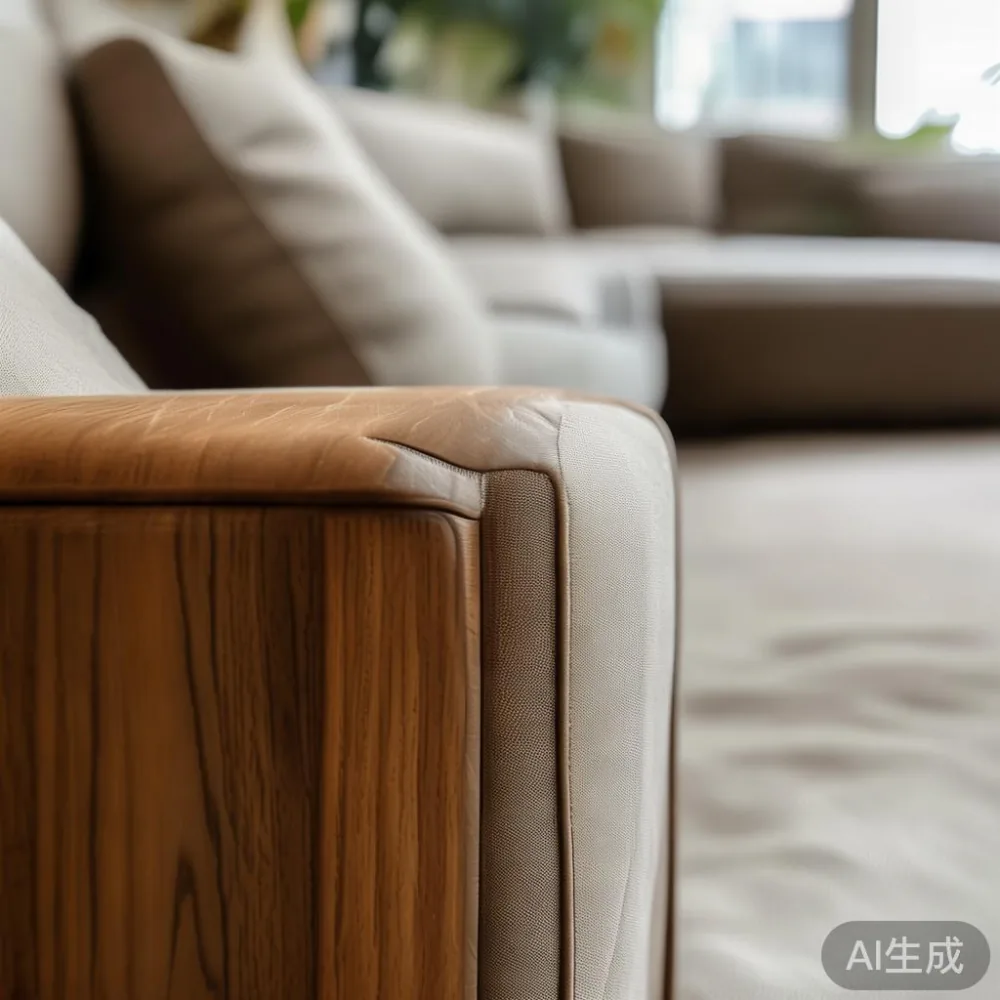
Run a finger along the underside of the armrest. Solid wood shows end-grain on the side panel and continuous grain along the face. If you see a repeating printed pattern, you are holding a veneer over particle board. Tap the frame: solid wood gives a dull thud, hollow cores give a sharp tap. Look at the corner blocks inside the base; they should be 4 cm x 4 cm minimum, glued AND dowelled, not stapled. Post-modern light-luxury frames often hide this joint behind a felt liner, so peel back the liner for the photo.
3. Foam Density and Recovery
Press the seat cushion with a flat palm for 10 seconds, then release. High-resilience foam recovers in under 3 seconds; cheap foam stays dented. Ask the supplier for the foam density in kg per cubic metre before purchase. Anything below 28 kg/m³ will sag within 18 months in Singapore's 32°C, 80% humidity climate. The same test applies to backrest pillows, which should weigh at least 1.2 kg each for a 50 cm x 50 cm cushion.
4. Fabric or Leather Gauge
For fabric, count the threads per cm with a loupe; a quality weave sits between 8 and 12 threads. For leather, check the back side: full grain shows natural pores, corrected grain shows a uniform stamped pattern. Bend a hidden corner of the cover. If white creases appear, the leather is split or bonded, and the warranty you thought you had just evaporated. Photograph the test area.
5. Hardware and Fasteners
Open the hardware bag and count every bolt, cam lock, and dowel against the parts list. French light-luxury frames often use zinc-alloy cam locks with a 15 mm diameter; anything smaller is a cost cut. A missing bolt is not a deal-breaker, but a missing bolt pattern tells you the frame was packed without a final QC sign-off. Keep the bag in a zip lock labelled with the date, because future warranty claims for wobble will reference the fastener type.
6. Marble or Stone Components
If your sofa ships with a marble table insert or a stone-topped side wing, lift the marble piece and listen. A solid marble slab above 18 mm thick sounds dense and heavy; a hollow sound means a 6 mm stone veneer over MDF. Marble should be sealed on all six sides, not just the visible top. Place a drop of water on an unseen corner: if it darkens within 60 seconds, the seal is missing and stains will follow.
7. Finish and Smell
Smell the wood within 30 cm of your nose. A mild linseed or wax scent is normal. A sharp chemical or sweet solvent smell indicates off-gassing from a low-grade lacquer, which is a health issue in a small HDB living room of around 18 m². Wipe a white cloth across an inner edge; any yellow or brown transfer means the finish is uncured and will mark your clothes.
8. Drawer and Door Alignment on Companion Pieces
If the shipment includes a nightstand, dining table, or wardrobe, open every drawer and door before signing the delivery note. Gaps should be uniform at 2 mm to 3 mm along the entire edge. Sliding doors should glide with two fingers; any resistance means a misaligned roller that will only worsen. Wardrobe hanging rails should sit at least 95 cm from the floor for full-length garments, and the back panel should not flex when you push between the shelves.
Documentation You Should Keep for the First 90 Days
File four things in a single phone album named "Sofa Proof": the invoice, the carton label photos, the inspection video, and the delivery note signed by the driver. Add the warranty card with the serial number typed into a note alongside the supplier's email and WhatsApp. In Singapore, the Consumer Protection (Fair Trading) Act gives you a 14-day window for outright returns on defective goods, and your photos timestamped within that window are hard evidence. For non-defective change-of-mind cases, most light-luxury brands charge a 15% to 25% restocking fee plus the return freight, which on a 2.4 m sofa can reach SGD 280 to SGD 450 depending on the vessel schedule from China.
Keep the original foam and corner protectors for 30 days. If a defect appears after the first week of use, the supplier may ask you to repack the piece for a technician visit, and reusing the factory foam saves you roughly SGD 60 in new wrapping. Label every bag with the room name and the date, because once three pieces arrive in a single shipment, the foam from the dining table does not fit the nightstand.
How Singapore's Building Constraints Shape Your Buying Decision
Singapore HDB lift capacities and corridor widths act as a silent filter on what you can actually own. A 2.8 m dining table cannot enter a unit on the 12th floor of a Bedok block unless the table splits into two 1.4 m halves, which adds joints and reduces the table's load rating. A wardrobe deeper than 60 cm will block the corridor turning radius into most bedrooms in older flats. A solid wood bed frame at 180 cm long usually fits, but a 200 cm king-size frame needs a stairwell transfer or a crane hoist from the ground floor, which adds SGD 220 to SGD 600 to the bill depending on the hour.
For garage storage specifically, the same logic applies in reverse. A 240 cm tall cabinet shipped in a flat-pack can be lifted fully assembled if the carton weight is below 45 kg, which keeps it inside the lift's safe load without overloading the counterweight. A heavier solid wood wardrobe needs to travel in two boxes, and the assembly location matters because HDB carparks cap delivery van idling at 30 minutes in many estates. Order early in the day, photograph the lift posted load, and book the corridor access with your Town Council if the piece is wider than 1.2 m, because the by-law requires at least 1.1 m of clear path for emergency egress.
Red Flags That Should Stop the Unboxing Immediately
Stop and call the supplier if you see any of the following: a crushed corner that has splintered into the wood rather than the cardboard, a foam cushion that arrives pre-flattened in the wrap, a missing or unreadable serial number on the frame, a chemical smell that lingers after 15 minutes of ventilation, or a hardware bag that contains fasteners of two different brands. Each of these is a documented reason for a partial refund or a full replacement under Singapore's Lemon law framework for goods above SGD 300 in value. Do not sign the delivery note as "accepted in good condition" until you have inspected, because that signature is the moment your use drops to near zero.
One more field note: weigh the empty carton after you empty it. A 2.4 m solid wood sofa carton should weigh between 8 kg and 14 kg including foam and wood crating. If the empty carton weighs 22 kg, the factory used a heavier grade of plywood as internal bracing, which sounds like a bonus but actually signals the frame inside needed extra protection during transit, meaning it may have shifted on the boat. Heavier cartons also mean heavier disposal, and HDB bulky item removal charges SGD 25 to SGD 60 per trip depending on the estate.
After the First 30 Days: Living With the Sofa
Once the inspection window closes, rotate the seat cushions weekly for the first month to even out the foam compression. Keep the room humidity between 55% and 65% with a dehumidifier set to 12 hours a day, because Singapore's ambient humidity near 80% will push solid wood to swell by 1% to 2% across the grain. Vacuum the underside every fortnight with a brush attachment, because dust buildup inside the frame attracts silverfish that love the starch in wood glue. Photograph the sofa in the same spot once a month under the same light, so any colour shift in the finish becomes visible over time and gives you a basis for the lifetime refinishing service many light-luxury brands such as MIDHILL offer to long-term owners.
Finally, treat the warranty card like a passport. Store the serial number, the invoice number, the supplier's contact, and the delivery date in two places: a printed copy taped under the sofa base, and a digital copy in your cloud drive. When the second-generation owner in your family inherits the piece five years from now, those five lines of text are the difference between a SGD 200 refinish and a SGD 1,800 replacement.